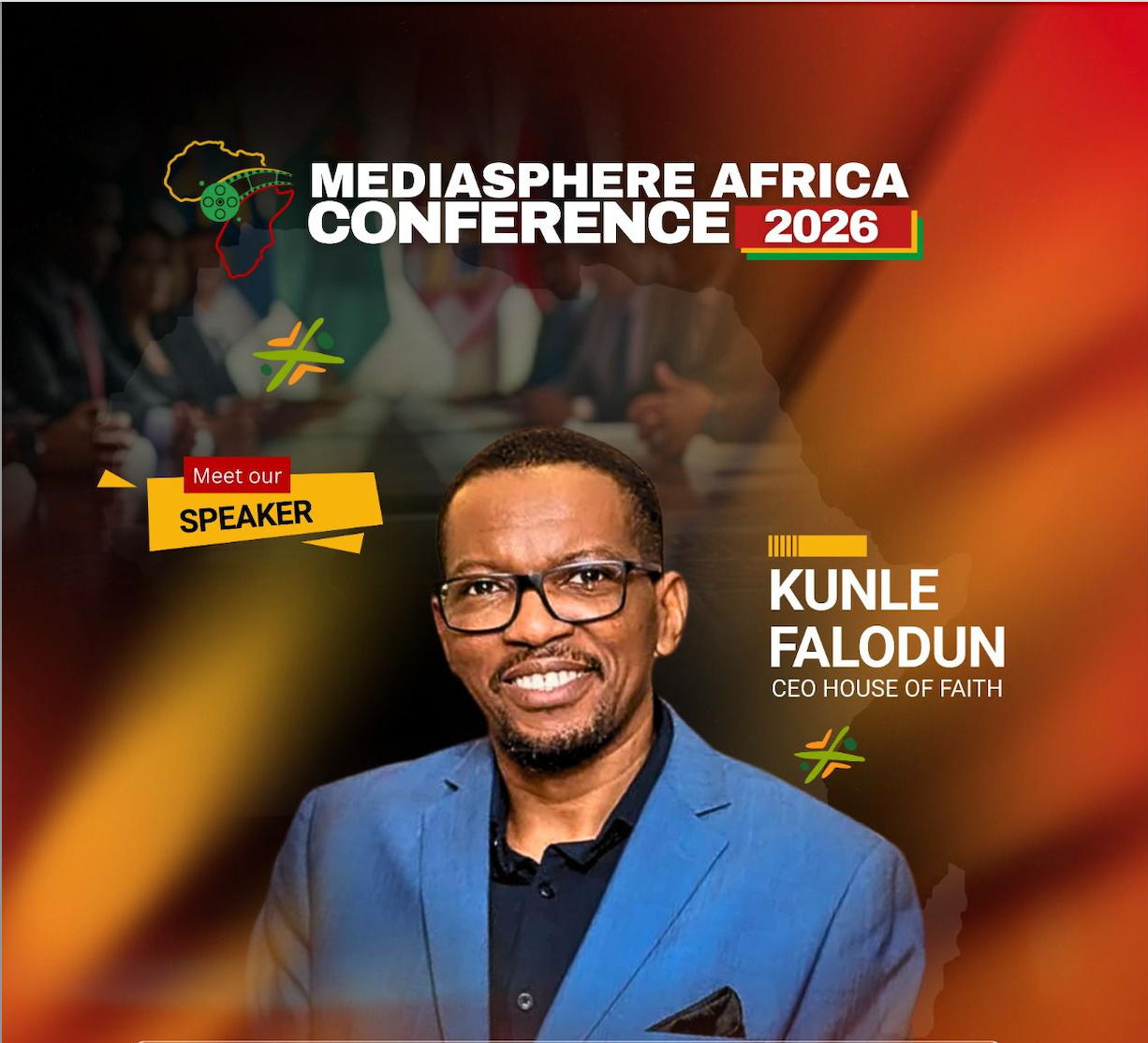
On Saturday 24 January, the global faith content community gathered at MediaSphere Africa Conference 2026, a one-day virtual gathering for Christian filmmakers, storytellers and media professionals.
A transcript of the keynote speech by House of Faith CEO & Co-founder, Kunle Falodun is reproduced below.

---
Mediasphere Africa 2026 - Keynote By Kunle Falodun [Full Transcript]
Good morning everyone,
I want to start by sincerely thanking the organisers for the privilege and honour of being asked to deliver this keynote address. It's such a good way to start the year.
Special thanks to Pastor Chim Onyebilama for facilitating my involvement today and I want to say a big congratulations to the ICVMA – this is a truly inspirational event.
I also want to acknowledge every other speaker today. I see many names on today’s programme who have inspired me personally and professionally as well as some very good friends, so I’m very much looking forward to the conversations that will follow.
My name is Kunle Falodun, and one of the most defining things about me is the journey I’ve had in this industry, a journey that has spanned about 25 years.
However, only a few months ago, I stepped away from my role at Sony Pictures Television, where I served as VP, Distribution and Networks for Africa, to co-found with a couple of amazing Christian executives – House of Faith, which is a faith-driven entertainment ecosystem.
Before Sony, I worked extensively across Sports and General entertainment content distribution, sponsorship and advertising throughout Africa in particular, but with a global focus.
It is therefore an exciting prospect for me today to be speaking today about: The State of African Media & Film Growth.
A friend and colleague of mine asked me a question which made me stop and think as I was preparing for this keynote address.
Her question was, “Why do you work in TV?” I stopped and thought for a minute and I think my answer is a good way to start the conversation this morning.
I wanted to work in TV because I have been attracted by the power of storytelling since I was a young kid. I travelled from my parents’ living room to lands far away and experienced different kinds of cultures right from my home due to the power of Television.
Media has the power to shape culture, define narratives, inspire, entertain and educate. To play a part in that, and touch lives the way mine has been touched has always been something that I have been engulfed with all my life.
Sometime last summer, while visiting family in the US, we decided to drive down to the Rocky Steps in Philadelphia – something I had wanted to do for a long time. On getting there, the experience I had made me come away with an even stronger realisation of the power of media.
This is epitomised by the fact that after several decades, there is still a steady flow of people – adults mostly by the way – hustling to take photographs with the statue of a fictional character from a 50-year-old movie, supported by the City authorities.
Therefore, the topic we are examining today is very pertinent not only to the growth of the industry, but to the development of the continent of Africa itself.
To really understand where African media is going, we have to remind ourselves of where we are coming from.
Over several decades, we have moved from state-controlled Free-to-Air television, to more commercial broadcast models, then to the Pay TV revolution with Canal+ shaping Francophone Africa, MultiChoice shaping Anglophone markets – both of them now having become one and shaping the whole of SSA together. As well as the many ambitious but short-lived experiments in between – Gateway, HiTV and Kwese are notable names that came and left, talk less of smaller regional players which came, lived and left with a whimper.
In a very unique way, we saw transactional models and physical media thriving. DVDs and VCDs particularly in markets like Nigeria built volume-driven industries long before streaming arrived and before the Telcos became central to just about every transaction in Sub-Saharan Africa, creating an imperfect but sustainable system for the growth of Nollywood.
The theatrical industry, however, remained limited. Outside of a few markets like South Africa, Nigeria, Kenya, cinema infrastructure never matched population growth. This, as we all know, remains a structural constraint for film monetisation.
Then finally came the streaming years, with the promise (that was never truly fulfilled) that the likes of Prime Video and Netflix represented, including local players like Showmax as well as the growing alternative that Youtube is now becoming.
Following this attempt to summarise Africa’s media journey, one can ask – so what have learnt so far from all these?
Africans have an insatiable appetite for stories that reflect their identity. We have seen how industries like Nollywood have survived despite all kinds of turbulence as a very valid example.
That hunger for relatability is precisely why the industry has grown into some sort of a global force despite well-known structural and quality challenges.
For decades, Africa was largely a transactional market. We consumed what the world sold us.
I personally grew up watching American, Indian and Chinese films sometimes without even knowing how they found their way to our screens.
But in 2026, the question is no longer how we receive content.
The question is how we sovereignly produce, distribute, and own it. Africa is no longer just a territory on a global media map.
We are fast becoming a centre of creative gravity.
As I mentioned, Africa eventually joined what many called the Streaming Gold Rush.
There was genuine optimism that global digital platforms would finally solve the continent’s distribution problems, fund ambitious projects, and unlock our long-awaited “Black Panther moments.”
But standing here in 2026, we must be honest: that hope has been tempered by reality.
What we are experiencing now is not exactly a rejection but selective realism.
Global capital has cooled. Platforms have realised that Africa is not a monolith. Different markets behave differently, and imported assumptions don’t always work here.
Here’s a sobering data point, and while exact percentages vary by country, the direction is clear: The vast majority of content consumed on digital platforms in Africa is still foreign.
In other words, we have built very sophisticated pipes but we are still filling them with water from distant wells.
Streaming gave us access, but it has not automatically given us ownership.
The hype phase is now over.
What remains is the harder work: figuring out how to make local stories commercially viable, without relying indefinitely on global handouts or using foreign strategy to solve local problems
Let's look at the opportunity presented by the reality of the true state of African media.
One of the most frequently cited indicators when discussing Africa’s media opportunity is the population both on the continent and across the African diaspora. And rightly so.
With 1.2 billion people, Africa is not just growing; it is also a young continent.
Sub-Saharan Africa remains the youngest region in the world, with average age hovering around 19–20 years, depending on the country.
This is a generation that is mobile-first, culturally expressive, and deeply connected to story, music, film, and faith.
Alongside this demographic reality, we are seeing measurable progress: Television penetration across Africa has steadily increased over the last decade, driven by digital terrestrial rollout – which has taken its time I must admit, but it's finally getting there and the slowly growing Pay TV expansion.
Local box office performance is improving, with African films increasingly dominating domestic charts in key markets like Nigeria, South Africa, and Kenya.
Streaming adoption, while uneven, continues to grow particularly among urban youth and diaspora audiences despite challenges around data costs, payments, and infrastructure. The Mobile Telcos continue to play a major role in streaming, though they get it wrong more often than not.
And then there is a less-discussed but critical opportunity: Globally, the faith-based media and entertainment industry is estimated to be worth approximately $45–50 billion, spanning film, television, publishing, music, and digital platforms. This is a significant and growing global market, not just a niche.
Yet Africa, one of the most faith-oriented regions in the world captures only a fraction of this value.
So when the data is taken together, one conclusion is clear:
The opportunity for exponential growth in African media is real.
But it will not be unlocked by population alone.
The path forward requires intentional strategy, so one has to consider the following:
-
Content that is culturally grounded, commercially viable, and distributed through systems designed for African economic realities.
-
Growth will not come from importing models wholesale, but from adapting them intelligently.
-
Africa does not need permission to tell its stories. It needs platforms, capital discipline, and the required execution excellence to scale them.
Let’s talk about math because in the media, when the math fails, the mission eventually fails with it. Like someone said, ‘the math needs math’.
Nigeria alone has well over 100 million internet users, and similar growth patterns exist across major African markets. Yet the streaming economics still don’t add up. Even the telcos offer all sorts of incentives and launch all sorts of services – in fact when I was at Sony Pictures, we did partner with a local Telco to launch an innovative service which perhaps could have worked if given more time, but the reality is, it didn’t quite take off.
So what is the problem? You are very familiar with some of the issues, so I won't dwell too much on them.
First, the data tax.
Video consumes the majority of mobile data globally – the number is well over two-thirds, and in Africa, the cost of data often exceeds the cost of the subscription itself.
Secondly, currency volatility remains a challenge.
Third, and more importantly for the Free TV industry, the measurement gap remains.
We still lack (apart from some limited markets) unified, trusted audience measurement across many African markets.
Without credible data, advertising spend which is increasingly digital struggles to flow back to producers, platforms and broadcasters at scale.
Fourthly, across much of the continent, we have roughly one cinema screen for almost a million people.
That means even the most successful local film struggles to generate enough box office revenue at home.
Though the situation continues to improve, when you compare the approximately 1,700 screens in the whole of Sub-Saharan Africa – with just about 300 in Africa’s most populous country, Nigeria – to China with 80,000 screens, we begin to see a serious challenge for the growth of Cinema.
So generally, we can conclude that we are digitally rich but economically fragmented.
Yes, South Africa stands out as a relatively mature market but without scalable progress across the rest of Sub-Saharan Africa, that success remains isolated, not transformational.
As I have just stated, we realise that the African cinema faces a very physical limitation that I call a screen deficit.
This constraint creates what I call the quality trap. Lower budgets often lead to compromised production values, which then limit global appeal and distribution opportunities.
But there are opportunities for us:
First is technology.
Perhaps we have to look at streaming differently. Yes, it has not been adopted as quickly as we thought, but perhaps we are looking at it wrong. We need a localised model. This is why our flagship product at House of Faith – Faithstream is adopting a FREE VOD/Donor supported model. As we realised that apart from the very heart of our mission – which is not for profit – actually doing the same thing the same way and expecting a different result they say is the first sign of madness, so we do need to find a different model.
Secondly, myself and my colleagues have been discussing the opportunities presented by short films – perhaps it's time we look at the length of the movies that we offer to the African audience. Can we develop a short film strategy? 30 minute films that when written well, can be satisfying and entertaining and by virtue of their length would be easier to consume by a mobile first audience.
Thirdly, the diaspora.
Millions of Africans abroad are deeply hungry for authentic, high-quality stories from home. They represent an economic bridge we have not fully built yet. How do we reach, engage and satisfy the diaspora?
Lastly, pseudo-cinemas. As infrastructure remains a challenge, how can we leverage existing spaces and create cottage cinemas before waiting for the investment that is not yet there in additional screens?
We must also close the expertise gag: world-class writing, development discipline, and production standards applied intentionally to African narratives. Though this is a chicken and egg story as the better funded the industry is, the better the quality of output will become.
When quality finally meets demand, the ceiling will not crack, it will shatter.
Lastly, we must look for guidance from above – as trivial as that sounds, as believers, we must not forget who the source of all wisdom is.
This brings me to what I believe is the most important part of today’s conversation for me.
As the secular entertainment industry expands, we increasingly see content that normalises values many of us find deeply troubling particularly for young, impressionable audiences.
Globally, faith-based content is growing, and that is encouraging. But much of it lacks an African pulse, African context, and African leadership.
At House of Faith, we are applying decades of secular media experience to a sacred mandate.
Through FaithStream, we are intentionally addressing the very challenges I’ve outlined today:
-
Access: creating a trusted sanctuary of faith-affirming content for Africans at home and in the diaspora. Free of charge, supported by donations and grants while ensuring the premium nature of the service we are offering. We have a saying that ‘we are free but not cheap’.
-
Empowerment: equipping faith-based creatives with training, technical skills, and global distribution not just exposure. Many faith-based creatives have been unable to do what they really want to do due to lack of demand. We are creating that demand.
-
Agenda: advancing a Christ-centred voice within global media and entertainment, without compromising excellence. Restoring some order, normalcy and decency in the industry.
The state of African media is expanding.
But the soul of African media is still searching.
Let’s give it something worth watching.
Thank you.

Share:
Entertainment, Media and Tech: Powerful Tools for Connecting Younger Generations to Faith
Four Days to Go: Conviction Plus Collaborative Structure